"Those who cannot remember the past are condemned to repeat it. (1)"
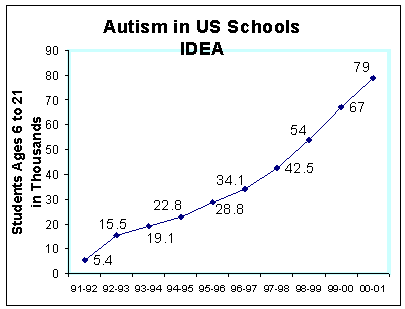
So often we forget. They changed the trash pick-up to Thursday, now I'm really screwed. Over a two year period less the same time past, 20 school children were taken to the hospital in Waimea. What happened? I forget. It happened again about 2 miles west. Twenty seven people have died of cancer in my neighborhood. Oh. There's a neighborhood in Wailua that has almost that many children diagnosed with A.S.D. (2). It's like Erin Brockovich. No. It's like Michael Clayton. That was a screen play, not real (3). Is Erin Brockovich real? Some parts. Communities were torn apart and change occurred. "Make a solemn promise: to enjoy our rightful part of the riches of this land, to throw off the yoke of being considered as agricultural implements or slaves. We are free men and we demand justice (4)."
1. George Santayana. The Life of Reason or The Phases of Human Progress: Reason in Common Sense 284 (2nd ed., Charles Scribner's Sons, New Your, New York 1924
2. Autism and Pesticide Exposure
http://maluiawcms.blogspot.com/2008/12/autism-and-pesticide-exposure.html
3. Askville by amazon: Is the movie Michael Clayton based on a true story?
http://askville.amazon.com/movie-Michael-Clayton-based-true-story/AnswerViewer.do?requestId=16234592
4. UC Davis: Cesar Chavez
http://www.blackgradsdavis.com/index.php?option=com_awiki&view=mediawiki&article=Cesar_Chavez?qsrc=3044
5. Image: "The Thinker" at the Rodin Museum, Philadelpia, PA
November 1, 2010
October 4, 2010
Leaching
to dissolve out by the action of a percolating liquid, taking away
"If you know your soil's potential for leaching and your pesticide's potential leaching, you are ready to determine the soil-pesticide interaction rating. You should know whether your soil has a high, intermediate, or low potential for leaching. You should also know whether your pesticide has a large, medium, small, or extra small potential for leaching. To see how these factors interact, refer to this chart (1)."
"If you know your soil's potential for leaching and your pesticide's potential leaching, you are ready to determine the soil-pesticide interaction rating. You should know whether your soil has a high, intermediate, or low potential for leaching. You should also know whether your pesticide has a large, medium, small, or extra small potential for leaching. To see how these factors interact, refer to this chart (1)."1. University of Illinois: College of Agricultural,
Consumer and Environmental Sciences, "50 Ways Farmers can Protect Groundwater", #24
September 1, 2010
MONOCULTURE
The cultivation or growth of a single crop or organism especially on agricultural or forest land.
"A growing number of people have become concerned about the long-term
sustainability of existing food production systems. Evidence has accumulated showing that whereas the present capital- and technology-intensive farming systems have been extremely productive and competitive, they also bring a variety of economic, environmental and social problems (2) ." "Evidence shows that the very nature of the agricultural structure and prevailing policies have led to this environmental crisis by favoring large farm size, specialized production, crop monocultures and mechanization... The lack of rotations and diversification take away key self-regulating mechanisms, turning monocultures into highly vulnerable agroecosystems dependent on high chemical inputs... An excessive reliance on monoculture farming and agroindustrial inputs, such as capital-intensive technology, pesticides, and chemical fertilizers, has negatively impacted the environment and rural society (3)" "The need to subsidize monocultures requires increases in the use of pesticides and fertilizers, but the efficiency of use of applied inputs is decreasing and crop yields in most key crops are leveling off. In some places, yields are actually in decline. There are different opinions as to the underlying causes of this phenomenon. Some believe that yields are leveling off because the maximum yield potential of current varieties is being approached, and therefore genetic engineering must be applied to the task of redesigning crop. Agroecologists, on the other hand, believe that the leveling off is because of the steady erosion of the productive base of agriculture through unsustainable practices (4)."
1. Merriam-Webster Dictionary
http://www.merriam-webster.com
2.Conway, G.R. and Pretty, J.N. 1991. Unwelcome harvest: agriculture and pollution. Earthscan Publisher, London.
3. Altieri, Miguel A. 2000. Modern Agriculture: Ecological impacts and the possibilities for truly sustainable farming
http://www.cnr.berkeley.edu/~agroeco3/modern_agriculture.html
4.Altieri, M.A. and P.M. Rosset 1995. Agroecology and the conversion of large-scale conventional systems to sustainable management. International Journal of Environmental Studies 50: 165-185.
"A growing number of people have become concerned about the long-term
sustainability of existing food production systems. Evidence has accumulated showing that whereas the present capital- and technology-intensive farming systems have been extremely productive and competitive, they also bring a variety of economic, environmental and social problems (2) ." "Evidence shows that the very nature of the agricultural structure and prevailing policies have led to this environmental crisis by favoring large farm size, specialized production, crop monocultures and mechanization... The lack of rotations and diversification take away key self-regulating mechanisms, turning monocultures into highly vulnerable agroecosystems dependent on high chemical inputs... An excessive reliance on monoculture farming and agroindustrial inputs, such as capital-intensive technology, pesticides, and chemical fertilizers, has negatively impacted the environment and rural society (3)" "The need to subsidize monocultures requires increases in the use of pesticides and fertilizers, but the efficiency of use of applied inputs is decreasing and crop yields in most key crops are leveling off. In some places, yields are actually in decline. There are different opinions as to the underlying causes of this phenomenon. Some believe that yields are leveling off because the maximum yield potential of current varieties is being approached, and therefore genetic engineering must be applied to the task of redesigning crop. Agroecologists, on the other hand, believe that the leveling off is because of the steady erosion of the productive base of agriculture through unsustainable practices (4)."1. Merriam-Webster Dictionary
http://www.merriam-webster.com
2.Conway, G.R. and Pretty, J.N. 1991. Unwelcome harvest: agriculture and pollution. Earthscan Publisher, London.
3. Altieri, Miguel A. 2000. Modern Agriculture: Ecological impacts and the possibilities for truly sustainable farming
http://www.cnr.berkeley.edu/~agroeco3/modern_agriculture.html
4.Altieri, M.A. and P.M. Rosset 1995. Agroecology and the conversion of large-scale conventional systems to sustainable management. International Journal of Environmental Studies 50: 165-185.
August 1, 2010
ED

ED: emotional disturbance
"Risk = Toxicity + Exposure"
A review of the "Characteristic Signs and Symptoms for Several Pesticide Active Ingredients and Classes of Pesticides" indicates varied states of emotional duress resulting from exposure to certain pesticides (2). Not listed, the pesticide Chlorpyrifos is widely used in the cultivation of GMO Corn on the island of Kauai. Psychiatric symptoms associated with acute exposure to Chlorpyrifos include anxiety, depression, memory loss, confusion, stupor, bizarre behavior, and restlessness. In children symptoms include seizures, flaccid muscle weakness, pupil constriction, excess salivation, and mental status changes including lethargy (3). Repeat or prolonged exposure to chlorpyrifos may result in the same effects as acute exposure, including the delayed symptoms. Other effects reported on workers repeatedly exposed include impaired memory and concentration, disorientation, severe depression, irritability, confusion, headache, speech difficulties, delayed reaction times, nightmares, sleepwalking and drowsiness or insomnia. An influenza-like condition with headache, nausea, weakness, loss of appetite and malaise has also been reported(4).
1. National Dissemination Center for Children with Disabilitieshttp://www.nichcy.org
2. Characteristic Signs and Symptoms for Several Pesticide...
http://www.cdc.gov/niosh/topics/pesticides/pdfs/pest-cd2app2v2.pdf
3. National Pesticide Information Center : "Chlorpyrifos Fact Sheet"
http://npic.orst.edu/factsheets/chlorptech.pdf
4. Chlorpyrifos Fact Sheet
http://www.pan-uk.org/pestnews/Actives/chlorpyr.htm
http://npic.orst.edu/factsheets/chlorptech.pdf
4. Chlorpyrifos Fact Sheet
http://www.pan-uk.org/pestnews/Actives/chlorpyr.htm
July 4, 2010
SLD

SLD: specific learning disabilities
"Risk = Toxicity + Exposure"
"Exposure is practically ubiquitous. We're all exposed (1)." Prior consideration of variables, a recent study found detectable levels of pesticide compounds in the urine of 94 percent of children tested. Research findings support the hypothesis that organophosphate exposure, at levels common among US children may contribute to ADHD prevalence (2). Seventeen percent of children in the United States have been diagnosed with one or more developmental disabilities. This percentage has risen dramatically in the past decade and continues to increase. These disabilities are... the result of complex interactions among genetic, environmental, and social factors that impact children during vulnerable periods of development. Research demonstrates that pervasive toxic substances, such as mercury, lead, PCBs, dioxins, pesticides, solvents, and others, can contribute to neurobehavioral and cognitive disorders (3). The US National Academy of Sciences estimates that at least 25% of learning and behavioral disabilities are due to either known toxic substances or the interactions between environmental factors and genetic predispositions(4).
Exposure to pesticides may lead to:
• Impairment of short-term memory
• Slower psychomotor and reaction speed
• Emotional instability, more frequent instances of anxiety, irritability, and depression
• Personality disorders or changes, mood changes
• Shortened attention spans, associated with ADHD (Attention deficit hyperactivitydisorder), which affects 3 to 6% of all school children
• Delays in physical stamina and hand-eye coordination
• Decreased number of brain cells and neurotransmitter receptors with exposure during critical points of development, that lead to significant IQ deficits and reading impairments
• Incomplete development of the fetal brain (5)
1. Author Maryse Bouchard of the University of Montreal
http://news.yahoo.com/s/ap/20100517/ap_on_he_me/us_med_children_pesticides
2. "Attention-Deficit/Hyperactivity Disorder and Urinary Metabolites of Organophosphate Pesticides"
http://pediatrics.aappublications.org/cgi/reprint/peds.2009-3058v1?maxtoshow=&hits=10&RESULTFORMAT=&fulltext=Bouchard&searchid=1&FIRSTINDEX=0&sortspec=relevance&resourcetype=HWCIT
3."In Harm's Way: Toxic Threats to Child Development": Physicians For Social Responsibility
http://www.psr.org/chapters/boston/resources/in-harms-way.html
4. "Our Stolen Future"
http://www.ourstolenfuture.org/NewScience/human/2000-09netreport.htm
5. "Pesticides and Learning Disabilities"
http://pesticidereform.org/downloads/pestandlearn.pdf
June 4, 2010
ADHD

ADHD: attention-deficit hyperactivity disorder
“Risk = Toxicity + Exposure”
Toxicity is the capacity of a chemical to cause harm to health. The amount needed to cause harm depends on the chemical. Like other chemicals, some pesticides are more toxic than others. A small quantity of a highly toxic pesticide can cause great harm..., the longer you are exposed the greater the chance of harm (1). A new analysis of U.S. health data links children's attention-deficit disorder with exposure to common pesticides... (2). The study found that the risk of having ADHD increases in children who have higher concentrations of dialkyl phosphate metabolites. The metabolites indicate exposure to organophosphates, pesticides that affect the nervous system. Those with higher-than-average levels of this metabolite were two times more likely to have ADHD than those whose levels were undetectable (3,4). The new study shows it's possible even tiny, allowable amounts of pesticide may affect brain chemistry (2,4).
1. What Are the Potential Health Effects of Pesticides? - California Department of Pesticide Regulation
http://www.cdpr.ca.gov/docs/dept/comguide/effects_excerpt.pdf
2. "Research links pesticide with ADHD in children"
http://news.yahoo.com/s/ap/20100517/ap_on_he_me/us_med_children_pesticides
3. "Attention-Deficit/Hyperactivity Disorder and Urinary Metabolites of Organophosphate Pesiticides" - Pediatrics, May 17
http://pediatrics.aappublications.org/cgi/content/abstract/peds.2009-3058v1
4. "Pesticides may increase risk of ADHD in children" - American Medical News
http://www.ama-assn.org/amednews/2010/05/31/prsb0531.htm
May 1, 2010
Malama I Ka Honua
"Cherish the Earth" - Journal of the Sierra Club, Hawaii Chapter
Malama I Ka Honua, a quarterly newsletter published by the Sierra Club in it's most recent issue recognized Maluhia Group for it's efforts. Maluhia Group members were named Pono award recipients for their work which resulted in an end to the spraying of chlorpyrifos and organophosphate pesticides on agricultural lands adjacent Waimea Canyon Middle School. Since pesticide application ceased there have been no "spikes" of illness indicative of pesticide exposure to students or staff. Previous illness "spikes" were attributed to the benign weed Cleome Gynandra by state, federal, and corporate investigators without scientific investigation despite illness symptoms being verbatim M.S.D.S. of known applied pesticides. Maluhia Group members continue their Community Based Participatory Research Project in an effort to:
- Determine the concentration of pesticides in the air at Waimea Canyon Middle School
- Review school health records, weather data, and known application dates to evaluate possible correlations of illness "spike" events with pesticide exposure.
- Use the data collected to renew a call for legislation eliminating the use of pesticides in close proximity of schools and communities.
- Inform the affected community and the media of the research project results.
- Provide free access to this data to be used as a benchmark for other communities addressing similar challenges through public forum and the Maluhia Group blog.
- Establish a statewide database of incidents involving pesticide drift and the adverse health effects of G.M.O. agriculture practices to individuals and the environment.
- Continue building the capacity to carry out advocacy work promoting viable alternatives to harmful, synthetic pesticides, by holding informative workshops, bringing in guest speakers, communicating information about pesticides to the public.
April 1, 2010
April Fool's
Trouble on the Farm...
1. Trouble on the Farm - Growing Up with Pesticides in Agricultural Communities
http://www.nrdc.org/health/kids/farm/chap2.asp
2. Practice Prevention
http://www.ldame.org/documents/ENVIRONMENTALRESEARCH-ChemicalPesticidesandChildrensHealth.pdf
2. Pictures of Field # 809 taken 02-24-2010
21-57-44.20N / 159-40-29.86W
Attempts to discover what happened to the County of Kauai City Council's $50,000 contribution to CTAHR to study
Cleome Gynandra have gone unanswered. This weed was blamed for 2 years of student and staff illness at Waimea Canyon Middle School on the island of Kauai. During acute incident's students and staff were taken to the hospital. Coincidentally, it's been 2 years since pesticide spraying on bordering ag land leased by Syngenta ceased and there have been no incidents of illness "spikes". Attached are photos taken on 02-24-2010 of Field #809 covered in blooming Cleome Gynandra. No one was taken to the hospital. The field was plowed under on 02-26-2010. This plowing cycle has been occurring for the past 2 years covering the campus in pesticide lading dust(2). Cleome Gynandra is the only weed that grows in the field now .
1. Trouble on the Farm - Growing Up with Pesticides in Agricultural Communities
http://www.nrdc.org/health/kids/farm/chap2.asp
2. Practice Prevention
http://www.ldame.org/documents/ENVIRONMENTALRESEARCH-ChemicalPesticidesandChildrensHealth.pdf
2. Pictures of Field # 809 taken 02-24-2010
21-57-44.20N / 159-40-29.86W
March 2, 2010
Vandana Shiva: The Future of Food - Part 3
"...the beginning of learning once again, what nature can do for us (1)."
1. Vandana Shiva: Future of Food - Part 3
http://www.youtube.com/watch?v=PQDqEUd53YQ
1. Vandana Shiva: Future of Food - Part 3
http://www.youtube.com/watch?v=PQDqEUd53YQ
February 1, 2010
Vandana Shiva: The Future of Food -Part 2
Unfortunately even computer genius Bill Gates has been sold the GMO solution to world hunger myth (1). Despite his renowned efforts with limited experiential knowledge, he should meet with more people like Dr. Vandana Shiva and less venture capitalist Frankenstein farmers. True long-term solutions for the world's hunger crisis do not require subjugation to corporations.
1. "The Daily Show": an interview with Bill Gates (1:53)
http://www.thedailyshow.com/watch/mon-january-25-2010/bill-gates
1. "The Daily Show": an interview with Bill Gates (1:53)
http://www.thedailyshow.com/watch/mon-january-25-2010/bill-gates
January 2, 2010
Introducing Dr. Vandana Shiva
...a physicist, ecologist, activist, editor and author of numerous books, Dr. Vandana Shiva is a tireless defender of the environment (1).
1. The My Hero Project - Dr. Vandana Shiva
http://www.myhero.com/myhero/hero.asp?hero=Shiva
2. Vandana Shiva:The Future of Food - Part 1
http://www.youtube.com/watch?v=vi1FTCzDSck
1. The My Hero Project - Dr. Vandana Shiva
http://www.myhero.com/myhero/hero.asp?hero=Shiva
2. Vandana Shiva:The Future of Food - Part 1
http://www.youtube.com/watch?v=vi1FTCzDSck
December 6, 2009
"What You Don't Know Can Kill You"
This article was originally posted on July 15th, 2007. With cultivation season upon us and pesticide use at it's highest amounts ever on the island of Kauai, we repost this resource.
The general term "pesticide" includes herbicides, fumigants, insecticides, nemacides, fungicides, miticides, rodenticides, termiticides, molluscides, acaricides, bird repellents and some wood preservatives (1).
In California, glyphosate is the third most commonly-reported cause of pesticide related illness among agricultural workers (2). The active ingredient in Syngenta's Touchdown product is glyphosate (3). Of the ten chemicals known to have been applied to Ag lands adjacent W.C.M.S (see Pesticide 101), glyphosate is the most
benign. Six of the chemicals are considered Cholinesterase inhibitors (4). While the effects of cholinesterase inhibiting products are intended for insect pests, these chemicals can also be poisonous, or toxic to humans in some situations. Human exposure to cholinesterase inhibiting chemicals can result from inhalation, ingestion, eye and skin contact during the manufacture, mixing, or applications of these pesticides (5). Unfortunately, signs and symptoms of cholinesterase inhibition from exposure can be confused with influenza (flu), heat prostration, alcohol intoxication, exhaustion, hypoglycemia (low blood sugar), asthma, gastroenteritis, pneumonia, and brain hemorrhage. This can cause problems if the symptoms of lowered cholinesterase levels are either ignored or misdiagnosed as something more or less harmful than they really are (5,6). To date Hawaii DOA/DOH has made no attempt to correlate the school health aide records of reported illness and/or staff statements with Syngenta spray operation application type, time & dates. Informal attempts show a significant correlation of spray dates and student/staff "spikes" of illness indicative of chronic pesticide exposure.
benign. Six of the chemicals are considered Cholinesterase inhibitors (4). While the effects of cholinesterase inhibiting products are intended for insect pests, these chemicals can also be poisonous, or toxic to humans in some situations. Human exposure to cholinesterase inhibiting chemicals can result from inhalation, ingestion, eye and skin contact during the manufacture, mixing, or applications of these pesticides (5). Unfortunately, signs and symptoms of cholinesterase inhibition from exposure can be confused with influenza (flu), heat prostration, alcohol intoxication, exhaustion, hypoglycemia (low blood sugar), asthma, gastroenteritis, pneumonia, and brain hemorrhage. This can cause problems if the symptoms of lowered cholinesterase levels are either ignored or misdiagnosed as something more or less harmful than they really are (5,6). To date Hawaii DOA/DOH has made no attempt to correlate the school health aide records of reported illness and/or staff statements with Syngenta spray operation application type, time & dates. Informal attempts show a significant correlation of spray dates and student/staff "spikes" of illness indicative of chronic pesticide exposure.1. Colorado Dept. of Health and Environment
http://www.cdphe.state.co.us/HM/hhw/howto/pesticides.htm
2. "Glyphosate Fact Sheet"
3. Product Details: Touchdown HiTech (Herbicide)
4. PAN Pesticides Database
5. "CHOLINESTERASE INHIBITION"
6. Image: "Manifestations of Organophosphate Insecticide Poisoning"
November 1, 2009
Action Alerts
your voice counts...
Earthjustice
"...we're asking the government to set safety standards protecting children who grow up near farms from the harmful effects of pesticide drift—the toxic spray or vapor that travels from treated fields. We're also asking officials to immediately adopt no-spray buffer zones around homes, schools, parks and daycare centers for the most dangerous and drift-prone pesticides... Children who live, go to school, and play near farms and orchards deserve to be kept safe from poisonous pesticides. Ask your congressperson to support this effort (1)."
Take action here:
Pesticide Action Network

"Despite campaign promises to the contrary, President Obama has nominated to two key posts “Big Ag” industry insiders who come straight from the chemical pesticide and biotechnology sectors. We need 50,000 signatures! To make this kind of impact, PAN is joining a broad coalition of partner groups from around the country in mobilizing to block these nominations (2)."
Take action here:
1. Earthjustice Action Alert:
http://action.earthjustice.org/campaign/pesticides_1009?rk=n7SmeW6qAqY7E
2.PAN Take Action:
http://action.panna.org/t/5185/petition.jsp?petition_KEY=2150
Earthjustice

"...we're asking the government to set safety standards protecting children who grow up near farms from the harmful effects of pesticide drift—the toxic spray or vapor that travels from treated fields. We're also asking officials to immediately adopt no-spray buffer zones around homes, schools, parks and daycare centers for the most dangerous and drift-prone pesticides... Children who live, go to school, and play near farms and orchards deserve to be kept safe from poisonous pesticides. Ask your congressperson to support this effort (1)."
Take action here:
Pesticide Action Network

"Despite campaign promises to the contrary, President Obama has nominated to two key posts “Big Ag” industry insiders who come straight from the chemical pesticide and biotechnology sectors. We need 50,000 signatures! To make this kind of impact, PAN is joining a broad coalition of partner groups from around the country in mobilizing to block these nominations (2)."
Take action here:
1. Earthjustice Action Alert:
http://action.earthjustice.org/campaign/pesticides_1009?rk=n7SmeW6qAqY7E
2.PAN Take Action:
http://action.panna.org/t/5185/petition.jsp?petition_KEY=2150
October 5, 2009
September 5, 2009
"Pesticides and You"
The Precautionary Principle
"When an activity raises threats of harm to human health or the environment, precautionary measures should be taken even if some cause and effect relationships are not fully established scientifically. In this context the proponent of an activity, rather than the public, should bear the burden of proof. The process of applying the precautionary principle must be open, informed, democratic, and must include potentially affected parties. It must also involve an examination of the full range of alternatives, including no action." - Wingspread Statement on the Precautionary Principle, Jan. 1998
"When an activity raises threats of harm to human health or the environment, precautionary measures should be taken even if some cause and effect relationships are not fully established scientifically. In this context the proponent of an activity, rather than the public, should bear the burden of proof. The process of applying the precautionary principle must be open, informed, democratic, and must include potentially affected parties. It must also involve an examination of the full range of alternatives, including no action." - Wingspread Statement on the Precautionary Principle, Jan. 19981. Science & Health Network: "The Precautionary Principle"
http://www.sehn.org/precaution.html
2. Science & Health Network: "Precautionary Principle" an essay by Michael Pollen
3. Guidelines for applying the Precautionary Principle to Biodiversity and Natural Resource Management, http://www.pprinciple.net/PP_guidelines_brochure.pdf
4. Beyond Pesticides: "Pesticides and You"
http://www.beyondpesticides.org/infoservices/pesticidesandyou/index.htm
http://www.sehn.org/precaution.html
2. Science & Health Network: "Precautionary Principle" an essay by Michael Pollen
3. Guidelines for applying the Precautionary Principle to Biodiversity and Natural Resource Management, http://www.pprinciple.net/PP_guidelines_brochure.pdf
4. Beyond Pesticides: "Pesticides and You"
http://www.beyondpesticides.org/infoservices/pesticidesandyou/index.htm
August 1, 2009
"Pesticides and You"
Exposure: an act of subjecting
An occupational exposure is the exposure to potentially harmful chemical, physical, or biological agents that occurs as a result of one's occupation. Exposure risk of children to organophosphorus pesticide in an agricultural community in Central Washington State was determined. Spot urine and hand wipe samples were collected from 109 children 9 months to 6 years of age, as were house dust samples, and wipe samples from various surfaces. Children were categorized based on parental occupation (agricultural vs nonagricultural) and on household proximity to pesticide-treated areas. Findings indicate that children living with parents who work with agricultural pesticides, or who live in proximity to pesticide treated farmland, have higher exposures than do other children living in the same community (3).
Children are the most susceptible population to environmental contaminants since: (a) their organs and neurological system are rapidly developing; (b) their intake (air, water, food, beverage) is greater relative to body size and weight; (c) their activities, behavior and proximity to the surfaces enhance their potential contact with toxic substances (4). For the pesticides examined, exposures pose greater risks of chronic effects than acute effects (5).
The Journal of American Medicine recommends adoption of pesticide spray buffer zones around schools (6). Surveys revealed that many farmworkers and their families are not adequately educated as to proper safety precautions. Misconceptions about post-application clean-up procedures and safe levels of proximity to treated crops may increase the risk of exposure for farmworker children (7).
1.Beyond Pesticides: "Pesticides and You"
http://www.beyondpesticides.org/infoservices/pesticidesandyou/index.htm
2. American Heritage Dictionary of the English Language: Exposure
http://education.yahoo.com/reference/dictionary/entry/exposure;_ylt=AqsmW.frLLHUOv41R_DzpLKsgMMF
3. Pesticide Exposure in Children in an Agricultural Community...
http://www.ncbi.nlm.nih.gov/pubmed/11097803
Mom's pesticide exposure at work increases her child's leukemia risk.
http://www.environmentalhealthnews.org/ehs/newscience/moms-pesticide-contact-at-work-increases-childs-leukemia-risk
4. Vulnerability of Young Children to Organophosphate Pesticides...
http://cfpub.epa.gov/ncer_abstracts/index.cfm/fuseaction/display.abstractDetail/abstract/976
5. Evaluating Health Risks from Occupational Exposure to Pesticides and the Regulatory Response
http://www.ehponline.org/docs/1994/102-12/woodruff.html
6 . JAMA: Acute Illnesses Associated With Pesticide Exposure at Schools
http://jama.ama-assn.org/cgi/reprint/294/4/455.pdf
7. Farmworker Children
http://www.panna.org/opsAbstracts/fwchildren
An occupational exposure is the exposure to potentially harmful chemical, physical, or biological agents that occurs as a result of one's occupation. Exposure risk of children to organophosphorus pesticide in an agricultural community in Central Washington State was determined. Spot urine and hand wipe samples were collected from 109 children 9 months to 6 years of age, as were house dust samples, and wipe samples from various surfaces. Children were categorized based on parental occupation (agricultural vs nonagricultural) and on household proximity to pesticide-treated areas. Findings indicate that children living with parents who work with agricultural pesticides, or who live in proximity to pesticide treated farmland, have higher exposures than do other children living in the same community (3).
Children are the most susceptible population to environmental contaminants since: (a) their organs and neurological system are rapidly developing; (b) their intake (air, water, food, beverage) is greater relative to body size and weight; (c) their activities, behavior and proximity to the surfaces enhance their potential contact with toxic substances (4). For the pesticides examined, exposures pose greater risks of chronic effects than acute effects (5).
The Journal of American Medicine recommends adoption of pesticide spray buffer zones around schools (6). Surveys revealed that many farmworkers and their families are not adequately educated as to proper safety precautions. Misconceptions about post-application clean-up procedures and safe levels of proximity to treated crops may increase the risk of exposure for farmworker children (7).
1.Beyond Pesticides: "Pesticides and You"
http://www.beyondpesticides.org/infoservices/pesticidesandyou/index.htm
2. American Heritage Dictionary of the English Language: Exposure
http://education.yahoo.com/reference/dictionary/entry/exposure;_ylt=AqsmW.frLLHUOv41R_DzpLKsgMMF
3. Pesticide Exposure in Children in an Agricultural Community...
http://www.ncbi.nlm.nih.gov/pubmed/11097803
Mom's pesticide exposure at work increases her child's leukemia risk.
http://www.environmentalhealthnews.org/ehs/newscience/moms-pesticide-contact-at-work-increases-childs-leukemia-risk
4. Vulnerability of Young Children to Organophosphate Pesticides...
http://cfpub.epa.gov/ncer_abstracts/index.cfm/fuseaction/display.abstractDetail/abstract/976
5. Evaluating Health Risks from Occupational Exposure to Pesticides and the Regulatory Response
http://www.ehponline.org/docs/1994/102-12/woodruff.html
6 . JAMA: Acute Illnesses Associated With Pesticide Exposure at Schools
http://jama.ama-assn.org/cgi/reprint/294/4/455.pdf
7. Farmworker Children
http://www.panna.org/opsAbstracts/fwchildren
July 6, 2009
"Pesticides and You"
Alternatives to pesticide use...
In our continued effort to provide current accurate, researched based, information on the adverse effects of pesticides and GMO agriculture, we begin a series of articles which will share resources you can download in reference to "Pesticides and You".
The Northwest Coalition for Alternatives to Pesticides protects the health of people and the environment by advancing alternatives to pesticides. Information fact sheets on alternatives to pesticide use to control pests and weeds can be located at, http://www.pesticide.org/factsheets.html
1. The Northwest Coalition for Alternatives to Pesticides Homepage
http://www.pesticide.org/default.htm
2.Beyond Pesticide: "Pesticides and you"
http://www.beyondpesticides.org/infoservices/pesticidesandyou/index.htm
3. Image: Pesticide Free Zone
http://www.gardenoforganicdelights.org/PesticideFreeZone.jpg
4. Alternatives to Pesticide PDF
http://www.bernards.org/boards_commissions/green_team/pptdocfolder/Alternative%20Pesticides.pdf
In our continued effort to provide current accurate, researched based, information on the adverse effects of pesticides and GMO agriculture, we begin a series of articles which will share resources you can download in reference to "Pesticides and You".
The Northwest Coalition for Alternatives to Pesticides protects the health of people and the environment by advancing alternatives to pesticides. Information fact sheets on alternatives to pesticide use to control pests and weeds can be located at, http://www.pesticide.org/factsheets.html
1. The Northwest Coalition for Alternatives to Pesticides Homepage
http://www.pesticide.org/default.htm
2.Beyond Pesticide: "Pesticides and you"
http://www.beyondpesticides.org/infoservices/pesticidesandyou/index.htm
3. Image: Pesticide Free Zone
http://www.gardenoforganicdelights.org/PesticideFreeZone.jpg
4. Alternatives to Pesticide PDF
http://www.bernards.org/boards_commissions/green_team/pptdocfolder/Alternative%20Pesticides.pdf
June 15, 2009
Free Movie
Waimea Theater - June 23rd, 2009from 7pm to 9pm
1. Free Movie*** The World According to Monsanto: Waimea Theater June 23rd, 2009.
http://surfriderkauai.ning.com/events/free-movie-the-world-according
2. "The World According to Monsanto": Controlling Our Food - French Documentary
http://video.google.com/videoplay?docid=6262083407501596844
"The World According to Monsanto"
1. Free Movie*** The World According to Monsanto: Waimea Theater June 23rd, 2009.
http://surfriderkauai.ning.com/events/free-movie-the-world-according
2. "The World According to Monsanto": Controlling Our Food - French Documentary
http://video.google.com/videoplay?docid=6262083407501596844
May 17, 2009
Stewards of the Land?
Dow and dirty...
According to news reports, the latest player in Kauai's transgenic seed corn industry will be Dow Chemical. 3400 acres of red Westside soil will be planted with corn and soybeans destined not for the dinner plates of Kauai's people. The seed corn business, which dominates the west Kauai landscape continues to bloom, or explode. Dow has indicated that it intends to continue the tradition of "good land stewardship that Gay & Robinson has demonstrated over past decades" (1).
What kind of stewardship record does Dow have? They are the second largest chemical manufacturer in the world and have brought us historic products such as napalm and agent orange. Both chemicals memorialized by the legacy of death and deformation to those exposed during the Vietnam War. Dow headquarters in Modland, Michigan is the source point for dioxin's that will contaminat the land and water for generations to come.
In 2003, the state of New York won a $2 million claim against Dow for advertising Chlorpyrifos as "safe." A nerve toxin and endocrine disruptor; Chlorpyrifos is still used by agribusiness primarily in developing countries and the fields of Kauai.
Dow's legacy of environmental and social injustice is too long to list in this article. They now join a list of multi-national chemical corporations participating in a Kauai land grab not seen since the Great Mahele. At what benefit? At what cost?
1. Star bulletin
http://www.starbulletin.com/business/20090429_Dow_AgroScience_to_lease_Kauai_sugar_lands.htm
2. Students for Bhopal
http://www.studentsforbhopal.org/DirtyDow.htm#DangerousNeighbor
3. Stewards of the Land?
http://www.box.net/shared/nc102hq2ai
4. Dow Chemcial Company
http://www.dow.com/
According to news reports, the latest player in Kauai's transgenic seed corn industry will be Dow Chemical. 3400 acres of red Westside soil will be planted with corn and soybeans destined not for the dinner plates of Kauai's people. The seed corn business, which dominates the west Kauai landscape continues to bloom, or explode. Dow has indicated that it intends to continue the tradition of "good land stewardship that Gay & Robinson has demonstrated over past decades" (1).
What kind of stewardship record does Dow have? They are the second largest chemical manufacturer in the world and have brought us historic products such as napalm and agent orange. Both chemicals memorialized by the legacy of death and deformation to those exposed during the Vietnam War. Dow headquarters in Modland, Michigan is the source point for dioxin's that will contaminat the land and water for generations to come.
In 2003, the state of New York won a $2 million claim against Dow for advertising Chlorpyrifos as "safe." A nerve toxin and endocrine disruptor; Chlorpyrifos is still used by agribusiness primarily in developing countries and the fields of Kauai.
Dow's legacy of environmental and social injustice is too long to list in this article. They now join a list of multi-national chemical corporations participating in a Kauai land grab not seen since the Great Mahele. At what benefit? At what cost?
1. Star bulletin
http://www.starbulletin.com/business/20090429_Dow_AgroScience_to_lease_Kauai_sugar_lands.htm
2. Students for Bhopal
http://www.studentsforbhopal.org/DirtyDow.htm#DangerousNeighbor
3. Stewards of the Land?
http://www.box.net/shared/nc102hq2ai
4. Dow Chemcial Company
http://www.dow.com/
April 9, 2009
Theater 101
Staged: the scene of an event or of a series of events, untrue.
The existing condition or state of affairs is known as the status quo. Staged events occurring are not always presented for viewing, but as an illusion. Take for instance a white lab coat. I'm ready to allow the cosmetics girl at Macy's to do my hip replacement. "Sorry if I offended you. I didn't know you didn't have a background in science."Fortunately her goals do not threaten biodiversity. Or, take for instance an air sampler in June taking samples on the roof of a building for "asbestos". Looks official, sounds official, somethings wrong? Lets' set up another one at the Dept. of Labor guy's house. Good idea, high five. A stage is not a platform when it is a position. A study is not a study when it is staged. It's beyond amazing what some do to ensure a status quo. In fact it's criminal. You'll find what you look for. Our C.B.P.R. continues...
1. Image: Dr. Evil
2. C.P.B.R: see April 17th, 2008 blog entry.
https://www1.georgetown.edu/centers/socialjustice/
The existing condition or state of affairs is known as the status quo. Staged events occurring are not always presented for viewing, but as an illusion. Take for instance a white lab coat. I'm ready to allow the cosmetics girl at Macy's to do my hip replacement. "Sorry if I offended you. I didn't know you didn't have a background in science."Fortunately her goals do not threaten biodiversity. Or, take for instance an air sampler in June taking samples on the roof of a building for "asbestos". Looks official, sounds official, somethings wrong? Lets' set up another one at the Dept. of Labor guy's house. Good idea, high five. A stage is not a platform when it is a position. A study is not a study when it is staged. It's beyond amazing what some do to ensure a status quo. In fact it's criminal. You'll find what you look for. Our C.B.P.R. continues...
1. Image: Dr. Evil
2. C.P.B.R: see April 17th, 2008 blog entry.
https://www1.georgetown.edu/centers/socialjustice/
March 9, 2009
"THE APPEAL"
by John Grisham
Hawaii - 2009
While the media whips up an emotional tide of focus on House Bill 444 (RELATING TO CIVIL UNIONS); as if using John Grisham's novel "The Appeal" as a script, House Bill 1226 (RELATING TO GENETICALLY MODIFIED PLANT ORGANISMS) slithers it's way through the Hawaii State Legislature with little opposition.
OPPOSE HB 1226
Write letters of opposition to:
Hawaii State Legislature House of Representatives
Agricultural Committee
http://www.capitol.hawaii.gov/site1/house/comm/commAGR.asp
Send testimony in opposition to:
Hawaii State Legislature
Submit Testimony by Email
http://www.capitol.hawaii.gov/emailtestimony/Default.aspx
Hawaii - 2009
While the media whips up an emotional tide of focus on House Bill 444 (RELATING TO CIVIL UNIONS); as if using John Grisham's novel "The Appeal" as a script, House Bill 1226 (RELATING TO GENETICALLY MODIFIED PLANT ORGANISMS) slithers it's way through the Hawaii State Legislature with little opposition.
OPPOSE HB 1226
Write letters of opposition to:
Hawaii State Legislature House of Representatives
Agricultural Committee
http://www.capitol.hawaii.gov/site1/house/comm/commAGR.asp
Send testimony in opposition to:
Hawaii State Legislature
Submit Testimony by Email
http://www.capitol.hawaii.gov/emailtestimony/Default.aspx
February 22, 2009
"Fleecing the Flock"
"Wolves in Sheep's Clothing"
A quite pall has encroached upon the beauty of Hawaii. Given cart blanche by federal and state government; biotechnology companies have become the islands most dangerous invasive species. As biotech's Petri dish of the Pacific, no other place in the world has the acreage of open air test fields as in Hawaii. With many of these test field's only short distances from communities and school's, Hawaii's citizens have unwittingly become the biotech industries human test subjects (i.e. guinea pigs). Believe in science? In a recent N.Y. Times article titled Crop Scientists Say Biotechnology Seed Companies Are Thwarting Research author Andrew Pollack writes, "Biotechnology companies are keeping university scientists from fully researching the effectiveness and environmental impact of the industry's genetically modified crops, according to an unusual complaint issued by a group of those scientists." History repeats itself. How many books need to be written, movies made before we learn to beware of wolves in sheep's clothing, those that bare false gifts, and in Hawaii's case fascists in farmers clothes? Please SUPPORT SB 239 "Right to Know" Bill and OPPOSE HB 1226 "Subjugation" Bill.
1. "Crop Scientists Say Biotechnology Seed Companies Are Thwarting Research," by Andrew Pollack
http://www.nytimes.com/2009/02/20/business/20crop.html?_r=1
2. Hawaii State SB 239: "Right to Know" Bill; HB 1226: "Subjugation" Bill
http://www.capitol.hawaii.gov/session2009/bills/SB239_SD1_.pdf
http://www.capitol.hawaii.gov/session2009/bills/HB1226_HD1_.pdf
A quite pall has encroached upon the beauty of Hawaii. Given cart blanche by federal and state government; biotechnology companies have become the islands most dangerous invasive species. As biotech's Petri dish of the Pacific, no other place in the world has the acreage of open air test fields as in Hawaii. With many of these test field's only short distances from communities and school's, Hawaii's citizens have unwittingly become the biotech industries human test subjects (i.e. guinea pigs). Believe in science? In a recent N.Y. Times article titled Crop Scientists Say Biotechnology Seed Companies Are Thwarting Research author Andrew Pollack writes, "Biotechnology companies are keeping university scientists from fully researching the effectiveness and environmental impact of the industry's genetically modified crops, according to an unusual complaint issued by a group of those scientists." History repeats itself. How many books need to be written, movies made before we learn to beware of wolves in sheep's clothing, those that bare false gifts, and in Hawaii's case fascists in farmers clothes? Please SUPPORT SB 239 "Right to Know" Bill and OPPOSE HB 1226 "Subjugation" Bill.
1. "Crop Scientists Say Biotechnology Seed Companies Are Thwarting Research," by Andrew Pollack
http://www.nytimes.com/2009/02/20/business/20crop.html?_r=1
2. Hawaii State SB 239: "Right to Know" Bill; HB 1226: "Subjugation" Bill
http://www.capitol.hawaii.gov/session2009/bills/SB239_SD1_.pdf
http://www.capitol.hawaii.gov/session2009/bills/HB1226_HD1_.pdf
January 9, 2009
"Stinky Study" (part 2)
Confused: lacking logical order or sense.
Former Kauai County Council Vice Chair Mel Rapozo introduced Bill 2278 with good intentions. Along with a disregard for cultural sensibility, an understanding of how the $50,000 of county funds will be used is unclear even to the Bill's protagonist.
1. "Stinky Study" (part 2); excerpt from Kauai County Council meeting 10/09/2008.
http://www.youtube.com/watch?v=cCCYHnKEw4g
Former Kauai County Council Vice Chair Mel Rapozo introduced Bill 2278 with good intentions. Along with a disregard for cultural sensibility, an understanding of how the $50,000 of county funds will be used is unclear even to the Bill's protagonist.
1. "Stinky Study" (part 2); excerpt from Kauai County Council meeting 10/09/2008.
http://www.youtube.com/watch?v=cCCYHnKEw4g
December 11, 2008
Autism and Pesticide Exposure
ASD: Autism Spectrum Disorder
According to scientist's and a growing body of
evidence maternal exposure to pesticide during specific gestation periods significantly increases the percentage of children born with ASD in a population. Autism Spectrum Disorders (ASDs) include a range of developmental disabilities that are characterized by substantial impairments in social interaction and communication as well as the presence of unusual behaviors. The symptoms range from mild to very severe, appearing before the age of three and lasting throughout a person's life (1). With lead and mercury eliminated as significant factors, one study found that mothers living within 500m of sprayed field sites had a 6:1 ratio of children born with ASD as compared to mothers not living near treated field sites (2). Senator Hooser's Bill SB 3170 delineated a 1500ft pesticide-free buffer zone around schools. This Bill never made it out of committee the result of "farm, seed, and pesticide lobby," influence (3).
1. "Exposure of Organochlorine Pesticides Linked to Autism": Pesticide and You, Volume 27, Number 3, pg. 6, Fall 2007
2. "Maternal Residence Near Agricultural Pesticide Applications and Autism
Spectrum Disorders among Children in the California Central Valley"
Eric M. Roberts, Paul B. English, Judith K. Grether, Gayle C. Windham, Lucia Somberg, and Craig Wolff
3. "Guest Viewpoint" - Kaua'i legislative update by Senator Gary L. Hooser
http://www.kauaiworld/articles/2008/03/12/opinion/edito2.txt
Testimony: http://www.capitol.hawaii.gov/session2008/Testimony/SB3170_EDU-ENE-TIA_02-04-08_.pdf
Bill: http://www.capitol.hawaii.gov/session2008/bills/SB3170_SD1_.htm
4. "The Autism Awareness Ribbon"
http://media.compendiumblog.com/images/blog_images/ad9acc28-bdbc-47e0-b18f-cc7a46ae979e/cb669e2b-7bf1-4a52-bcbb-3567dcb3fb9f/Autism-Ribbon-Story.jpg
According to scientist's and a growing body of
evidence maternal exposure to pesticide during specific gestation periods significantly increases the percentage of children born with ASD in a population. Autism Spectrum Disorders (ASDs) include a range of developmental disabilities that are characterized by substantial impairments in social interaction and communication as well as the presence of unusual behaviors. The symptoms range from mild to very severe, appearing before the age of three and lasting throughout a person's life (1). With lead and mercury eliminated as significant factors, one study found that mothers living within 500m of sprayed field sites had a 6:1 ratio of children born with ASD as compared to mothers not living near treated field sites (2). Senator Hooser's Bill SB 3170 delineated a 1500ft pesticide-free buffer zone around schools. This Bill never made it out of committee the result of "farm, seed, and pesticide lobby," influence (3).1. "Exposure of Organochlorine Pesticides Linked to Autism": Pesticide and You, Volume 27, Number 3, pg. 6, Fall 2007
2. "Maternal Residence Near Agricultural Pesticide Applications and Autism
Spectrum Disorders among Children in the California Central Valley"
Eric M. Roberts, Paul B. English, Judith K. Grether, Gayle C. Windham, Lucia Somberg, and Craig Wolff
3. "Guest Viewpoint" - Kaua'i legislative update by Senator Gary L. Hooser
http://www.kauaiworld/articles/2008/03/12/opinion/edito2.txt
Testimony: http://www.capitol.hawaii.gov/session2008/Testimony/SB3170_EDU-ENE-TIA_02-04-08_.pdf
Bill: http://www.capitol.hawaii.gov/session2008/bills/SB3170_SD1_.htm
4. "The Autism Awareness Ribbon"
http://media.compendiumblog.com/images/blog_images/ad9acc28-bdbc-47e0-b18f-cc7a46ae979e/cb669e2b-7bf1-4a52-bcbb-3567dcb3fb9f/Autism-Ribbon-Story.jpg
November 10, 2008
"Stinky Study" (part 1)
Confound: To cause to become confused or perplexed; fail to distinguish, mix up.
Despite there being evidence that the lessee of Field #809 is cultivating Cleome Gynandra (see D.O.A. Part 9) and data available in reference to compounds yielded from this benign weed, Kauai County Council has agreed to fund $50,000 "to characterize and monitor for odoriferous compounds produced by Cleome Gynandra" (1,2). Within a few weeks of Bill 2278 passing, Governor Linda Lingle approved an additional $100,000 for the "testing and assessment of pesticide in the ambient air" (3). The responsibility of developing the study as well as data collection has been delegated to CTAHR Plant & Environmental Protection Services Dr. Qi Li, with oversight from Dr. Robert Boesch of the Hawaii State Department of Agriculture. Dr. Li will conduct the study of "odoriferous compounds" as well as the testing of pesticide levels in the ambient air for Hawaii Department of Agriculture. Dr. Li is also the Hawaii State Director of Pesticide Registration Program (4). The University of Hawaii at Manoa College of Tropical Agriculture and Human Resources (CTAHR) receives millions of dollars in endowments from the GMO seed industry which is its largest benefactor.
1. Botanical Dermatology Database: "Cleomaceae"
http://bodd.cf.ac.uk/BotDermFolder/CLEO.html
2. Letter to former Kauai County Council Vice Chair Mel Rapozo - July 3rd, 2008; pg. 2
http://www.box.net/shared/dj69fctcfh
3. The Garden Island Newspaper: "Westside Noxious Odor Study Funded"
http://www.kauaiworld.com/articles/2008/11/04/news/kauai_news/doc49offd826c59d999640816.txt
4. Pesticide Registration Program Department of Environmental Biochemistry (CTAHR), University of Hawaii at Manoa
http://pestworld.stjohn.hawaii.edu/epp/prp.html
Despite there being evidence that the lessee of Field #809 is cultivating Cleome Gynandra (see D.O.A. Part 9) and data available in reference to compounds yielded from this benign weed, Kauai County Council has agreed to fund $50,000 "to characterize and monitor for odoriferous compounds produced by Cleome Gynandra" (1,2). Within a few weeks of Bill 2278 passing, Governor Linda Lingle approved an additional $100,000 for the "testing and assessment of pesticide in the ambient air" (3). The responsibility of developing the study as well as data collection has been delegated to CTAHR Plant & Environmental Protection Services Dr. Qi Li, with oversight from Dr. Robert Boesch of the Hawaii State Department of Agriculture. Dr. Li will conduct the study of "odoriferous compounds" as well as the testing of pesticide levels in the ambient air for Hawaii Department of Agriculture. Dr. Li is also the Hawaii State Director of Pesticide Registration Program (4). The University of Hawaii at Manoa College of Tropical Agriculture and Human Resources (CTAHR) receives millions of dollars in endowments from the GMO seed industry which is its largest benefactor.
1. Botanical Dermatology Database: "Cleomaceae"
http://bodd.cf.ac.uk/BotDermFolder/CLEO.html
2. Letter to former Kauai County Council Vice Chair Mel Rapozo - July 3rd, 2008; pg. 2
http://www.box.net/shared/dj69fctcfh
3. The Garden Island Newspaper: "Westside Noxious Odor Study Funded"
http://www.kauaiworld.com/articles/2008/11/04/news/kauai_news/doc49offd826c59d999640816.txt
4. Pesticide Registration Program Department of Environmental Biochemistry (CTAHR), University of Hawaii at Manoa
http://pestworld.stjohn.hawaii.edu/epp/prp.html
October 18, 2008
"Pesticides and Childhood Cancer"
"A pernicious, spreading evil (1)."
Children living on or near treated croplands can be exposed (to pesticides) through agricultural application drift, overspray, or off-gassing. Young children, who are likely to spend a large proportion of their time on the floor or ground and who frequently put hands and objects in their mouths, may be at particularly high risk of exposure . Addressing the conspicuous absence of information on chemical exposures and toxicity relating to children has become a priority at the EPA (2). Evidence that pesticide exposure may be associated with childhood cancer comes from case reports and several types of epidemiologic studies. Evidence from epidemiological studies suggests that environmental contaminants such as pesticides and certain chemicals, in
addition to radiation, may contribute to an increased frequency of some childhood cancers. Some studies have found that children born to parents who work with or use such chemicals are more likely to have cancer in childhood (3). Malignancies linked to pesticides in studies include leukemia, neuroblastoma, Wilms' tumor, soft-tissue sarcoma, Ewing's sarcoma, non-Hodgkin's lymphoma, and cancers of the brain, colorectum, and testes. Many of the cancers associated with pesticides among children are the same cancers that are repeatedly associated with pesticide exposure among adults. There is a need to study and better quantify these exposures (4). Regulatory toxicology can no longer safely assume that "the dose makes the poison". Standard approaches used to develop estimates of safe exposure levels, by basing their design on a false assumption, are likely to have set safety standards that are not strong enough to protect public health (5). Although research is underway to characterize the risks of childhood cancer associated with pesticides and identify the specific pesticides responsible, it is prudent to reduce or, where possible, eliminate pesticide exposure to children, given their increased vulnerability and susceptibility. There is potential to prevent at least some childhood cancer by reducing or eliminating pesticide exposure (2,3,4).
1. American Heritage® Dictionary of the English Language: definition of "Cancer"
2. "Childhood Cancer: A Growing Problem", Environmental Health Perspectives Volume 106, Number1, January 1998
http://www.ehponline.org/realfiles/docs/1998/106-1/focus.html
3. "Cancer Incidence and Mortality," U.S. Environmental Protection Agency.
http://yosemite.epa.gov/ochp/ochpweb.nsf/content/childhood_cancer.htm
4. "Pesticides and Childhood Cancer" by Shelia Hoar Zahm and Mary H. Ward. Environmental Health Perspectives Supplements Volume 106, Number S3, June 1998. Occupational Epidemiology Branch, Division of Cancer Etiology, National Cancer Institute, Rockville, Maryland, http://www.ehponline.org/members/1998/Suppl-3/893-908zahm/zahm-full.html
5. "Does 'the dose make the poison?" Extensive results challenge a core assumption in toxicology, by Pete Myers, Ph.D. and Wendy Hessler
http://www.ourstolenfuture.org/NewScience/lowdose/2007/2007-04-30%20Does%20the%20Dose%20Make%20the%20Poison.pdf
6. Waimea Canyon Middle School and adjacent neighborhood shadowed by Field #809: Photo by Denis Fujimoto
Children living on or near treated croplands can be exposed (to pesticides) through agricultural application drift, overspray, or off-gassing. Young children, who are likely to spend a large proportion of their time on the floor or ground and who frequently put hands and objects in their mouths, may be at particularly high risk of exposure . Addressing the conspicuous absence of information on chemical exposures and toxicity relating to children has become a priority at the EPA (2). Evidence that pesticide exposure may be associated with childhood cancer comes from case reports and several types of epidemiologic studies. Evidence from epidemiological studies suggests that environmental contaminants such as pesticides and certain chemicals, in
addition to radiation, may contribute to an increased frequency of some childhood cancers. Some studies have found that children born to parents who work with or use such chemicals are more likely to have cancer in childhood (3). Malignancies linked to pesticides in studies include leukemia, neuroblastoma, Wilms' tumor, soft-tissue sarcoma, Ewing's sarcoma, non-Hodgkin's lymphoma, and cancers of the brain, colorectum, and testes. Many of the cancers associated with pesticides among children are the same cancers that are repeatedly associated with pesticide exposure among adults. There is a need to study and better quantify these exposures (4). Regulatory toxicology can no longer safely assume that "the dose makes the poison". Standard approaches used to develop estimates of safe exposure levels, by basing their design on a false assumption, are likely to have set safety standards that are not strong enough to protect public health (5). Although research is underway to characterize the risks of childhood cancer associated with pesticides and identify the specific pesticides responsible, it is prudent to reduce or, where possible, eliminate pesticide exposure to children, given their increased vulnerability and susceptibility. There is potential to prevent at least some childhood cancer by reducing or eliminating pesticide exposure (2,3,4). 1. American Heritage® Dictionary of the English Language: definition of "Cancer"
2. "Childhood Cancer: A Growing Problem", Environmental Health Perspectives Volume 106, Number1, January 1998
http://www.ehponline.org/realfiles/docs/1998/106-1/focus.html
3. "Cancer Incidence and Mortality," U.S. Environmental Protection Agency.
http://yosemite.epa.gov/ochp/ochpweb.nsf/content/childhood_cancer.htm
4. "Pesticides and Childhood Cancer" by Shelia Hoar Zahm and Mary H. Ward. Environmental Health Perspectives Supplements Volume 106, Number S3, June 1998. Occupational Epidemiology Branch, Division of Cancer Etiology, National Cancer Institute, Rockville, Maryland, http://www.ehponline.org/members/1998/Suppl-3/893-908zahm/zahm-full.html
5. "Does 'the dose make the poison?" Extensive results challenge a core assumption in toxicology, by Pete Myers, Ph.D. and Wendy Hessler
http://www.ourstolenfuture.org/NewScience/lowdose/2007/2007-04-30%20Does%20the%20Dose%20Make%20the%20Poison.pdf
6. Waimea Canyon Middle School and adjacent neighborhood shadowed by Field #809: Photo by Denis Fujimoto
September 20, 2008
D.O.A. (part 9)
"Body of Evidence" - Cindy Goldstein, Ph.D. (1)
Throughout this David and Goliath struggle of Environmental Injustice and Racism, the cause of repeated events of illness indicative of acute and chronic pesticide exposure has been blamed on the benign weed Cleome Gynandra. The heads of Hawaii Dept. of Ag and Dept. of Health have agreed to perform an ambient air study for pesticides only if the Kauai County Council provides $50,000 to fund an assessment of the "ambient concentrations of odiferous substances from Cleome Gynandra" (2). In a previous agreement with Hawaii State Teachers Association there was to be no cultivation or spraying in field #809 prior Dec. 08' unless Syngenta agreed to construct a 12-foot-high dust-fence along the vegetated buffer zone separating the field from the school (3). This is a video of the lessee of field #809 (Syngenta Seeds Co.) cultivating Cleome Gynandra a weed blamed for sending over 20 children to the hospital, contrary to that agreement.
1. "Body of Evidence", a quote from Cindy Goldstein, Ph.D.
Manager Business and Community Outreach Pioneer (A DUPONT COMPANY) Biotechnology Affairs, cindy.goldstein@pioneer.com
2. Bill 2278 info, http://www.box.net/shared/dj69fctcfh
3. The Garden Island Newspaper, Feb. 8, 2008
http://www.kauaiworld.com/articles/2008/02/08/news/news02.txt
4. D.O.A (part 9), "Diary of Apathy" the struggle continues...
http://www.youtube.com/watch?v=0SYEcowV2d8
5. Music: "Hawaii 78" by Bruddah IZ
Throughout this David and Goliath struggle of Environmental Injustice and Racism, the cause of repeated events of illness indicative of acute and chronic pesticide exposure has been blamed on the benign weed Cleome Gynandra. The heads of Hawaii Dept. of Ag and Dept. of Health have agreed to perform an ambient air study for pesticides only if the Kauai County Council provides $50,000 to fund an assessment of the "ambient concentrations of odiferous substances from Cleome Gynandra" (2). In a previous agreement with Hawaii State Teachers Association there was to be no cultivation or spraying in field #809 prior Dec. 08' unless Syngenta agreed to construct a 12-foot-high dust-fence along the vegetated buffer zone separating the field from the school (3). This is a video of the lessee of field #809 (Syngenta Seeds Co.) cultivating Cleome Gynandra a weed blamed for sending over 20 children to the hospital, contrary to that agreement.
1. "Body of Evidence", a quote from Cindy Goldstein, Ph.D.
Manager Business and Community Outreach Pioneer (A DUPONT COMPANY) Biotechnology Affairs, cindy.goldstein@pioneer.com
2. Bill 2278 info, http://www.box.net/shared/dj69fctcfh
3. The Garden Island Newspaper, Feb. 8, 2008
http://www.kauaiworld.com/articles/2008/02/08/news/news02.txt
4. D.O.A (part 9), "Diary of Apathy" the struggle continues...
http://www.youtube.com/watch?v=0SYEcowV2d8
5. Music: "Hawaii 78" by Bruddah IZ
September 11, 2008
Cocktail Anyone?
"Inerts" (Part 2)
CLICK HERE: The following is an ingredient list of the pesticide cocktail that was applied by Syngenta Seeds Inc. to field #809 during the week leading up to the January 25, 2008 incident (2).
Syngenta pesticide application data was provided by the Department of Agriculture (3).
1. YouTube Video: "The Day After, 01-26-08"
http://www.youtube.com/watch?v=D5xefxsmXcc
2. "A Case Study of a Week-Long Pesticide Cocktail"
http://www.box.net/shared/p7tz40zs4d
3. Dept. of Agriculture Inspection Report: 01-28-09, 02-08-08,02-09-08
A Case Study of a Week-Long Pesticide Cocktail
Recap: on January 25, 2008, more than 60 students at Waimea Canyon Middle School reported to the health room with complaints of nausea, dizziness, itcy eyes, sore throat, and labored breathing(1). Many reported smelling a noxious fuel-like odor. Responding emergency services personnel took 12 students and 1 teacher to the Kauai Veterans Memorial Hospital ER for treatment of acute symptoms ranging from difficulty breathing, violent vomiting, dizziness, tremors, and extreme headache. Classrooms were evacuated to the library which is a contained environment with a central air conditioning system. Representatives from state and county agencies as well as agribusiness converged upon the campus in an effort to determine the cause of the noxious odor and sickness. By 4pm that same day the Honolulu Advertiser reported that "officials" determined the culprit odor (and consequent sickness) to be caused by several piles of dead Cleome Gynandra located along the campus western boarder in field #809 (1). Many were surprised by this speedy conclusion given the magnitude of the incident; the benign nature of the weed, and the lack of anyone effected reporting that the odor they smelled was "Wild Spider Flower," an odor many on campus are familiar with.
CLICK HERE: The following is an ingredient list of the pesticide cocktail that was applied by Syngenta Seeds Inc. to field #809 during the week leading up to the January 25, 2008 incident (2). Syngenta pesticide application data was provided by the Department of Agriculture (3).
1. YouTube Video: "The Day After, 01-26-08"
http://www.youtube.com/watch?v=D5xefxsmXcc
2. "A Case Study of a Week-Long Pesticide Cocktail"
http://www.box.net/shared/p7tz40zs4d
3. Dept. of Agriculture Inspection Report: 01-28-09, 02-08-08,02-09-08
September 6, 2008
Are "Inerts" Benign?
Original post August 17th,2008
Cocktail: A mixture, usually in solution
Benign: Having little or no detrimental effect, harmless
When a pesticide poisoning is believed to have taken place, much
attention is usually paid to the active ingredient in the pesticide product. The percentage of active ingredient in a formulation can range form 5% to 90%. The other percentage of the product is a cocktail of chemicals ranging from solvents to lesser “active pesticides" (1). These other ingredients are often referred to as “inerts”. According to the U.S. Environmental Protection Agency, “an inert ingredient may have biological activity of it’s own, may be toxic to humans, and may be chemically active.” In 1997 the E.P.A. issued a notice which, “encourages manufacturers, formulators, producers, and registrants of pesticide products to voluntarily substitute the term ‘other ingredient’ as a heading for the inert ingredients in the ingredient statement on the label of the pesticide product.” “Many consumers are mislead by the term “inert ingredient,” believing it to mean “harmless” (2). State, federal, and international agencies have classified 26 percent of “inert ingredients” (about 600 chemicals) as hazardous.
1. "A Case Study of a Week-Long Pesticide Cocktail"
http://www.box.net/shared/p7tz40zs4d
2. Inert (other) Ingredients in Pesticide Products
http://www.epa.gov/opprd001/inerts/
Cocktail: A mixture, usually in solution
Benign: Having little or no detrimental effect, harmless
When a pesticide poisoning is believed to have taken place, much
attention is usually paid to the active ingredient in the pesticide product. The percentage of active ingredient in a formulation can range form 5% to 90%. The other percentage of the product is a cocktail of chemicals ranging from solvents to lesser “active pesticides" (1). These other ingredients are often referred to as “inerts”. According to the U.S. Environmental Protection Agency, “an inert ingredient may have biological activity of it’s own, may be toxic to humans, and may be chemically active.” In 1997 the E.P.A. issued a notice which, “encourages manufacturers, formulators, producers, and registrants of pesticide products to voluntarily substitute the term ‘other ingredient’ as a heading for the inert ingredients in the ingredient statement on the label of the pesticide product.” “Many consumers are mislead by the term “inert ingredient,” believing it to mean “harmless” (2). State, federal, and international agencies have classified 26 percent of “inert ingredients” (about 600 chemicals) as hazardous.1. "A Case Study of a Week-Long Pesticide Cocktail"
http://www.box.net/shared/p7tz40zs4d
2. Inert (other) Ingredients in Pesticide Products
http://www.epa.gov/opprd001/inerts/
July 16, 2008
Troubles in Paradise (Kauai)
"Citizens not Serfs"
1. Troubles in Paradise (Kauai)- a Zaharie Productions video
https://www.youtube.com/watch?v=Avk0r6JdafA
1. Troubles in Paradise (Kauai)- a Zaharie Productions video
https://www.youtube.com/watch?v=Avk0r6JdafA
Subscribe to:
Posts (Atom)